SYSTEM_INTERNALS
Engineered for subterranean durability, extreme battery autonomy, and high-frequency transient surveillance in water distribution assets.
NRF54LM20A + 5 kHz HSPA™
Nordic 22nm ARM Cortex-M33 @ 128 MHz with continuous 5,000 samples/sec 12-bit SAADC loop. Captures water hammer shockwaves, pump surges, and transient ruptures.
2MB ON-CHIP RRAM
1.52 MB dedicated storage partition holding 75,000 records (>2.1 years history). Byte-writable Resistive RAM with zero page-erase penalty and no external memory chips.
1-HOUR MOTION SLEEP
LIS2DW12 3-axis accelerometer automatically shuts down BLE radio after 1 hour stationary. Shaking or tapping the logger (≥10% motion delta) instantly re-arms BLE advertising.
OFFLINE PWA (/webapp)
Zero app installation, zero cables. Field technicians connect over Web Bluetooth directly inside Chrome to run 2-point calibration, oscilloscope diagnostics, and CSV log exports.
POWER-GATED GNSS (0 µA)
MOSFET power gate on P3.10 achieves 0 µA zero quiescent draw when idle. On-demand fix lock saves GPS coordinates permanently to RRAM ZMS with Google Maps link generation.
RS485 TANK & MULTI-BUS
Direct support for water storage tanks and reservoirs using submersible hydrostatic pressure sensors (RS-485 Modbus, 10m vented PUR cable). Plus BME280 chamber diagnostics and SDI-12 / Pulse expansion.
TELEMETRY_INTERFACE
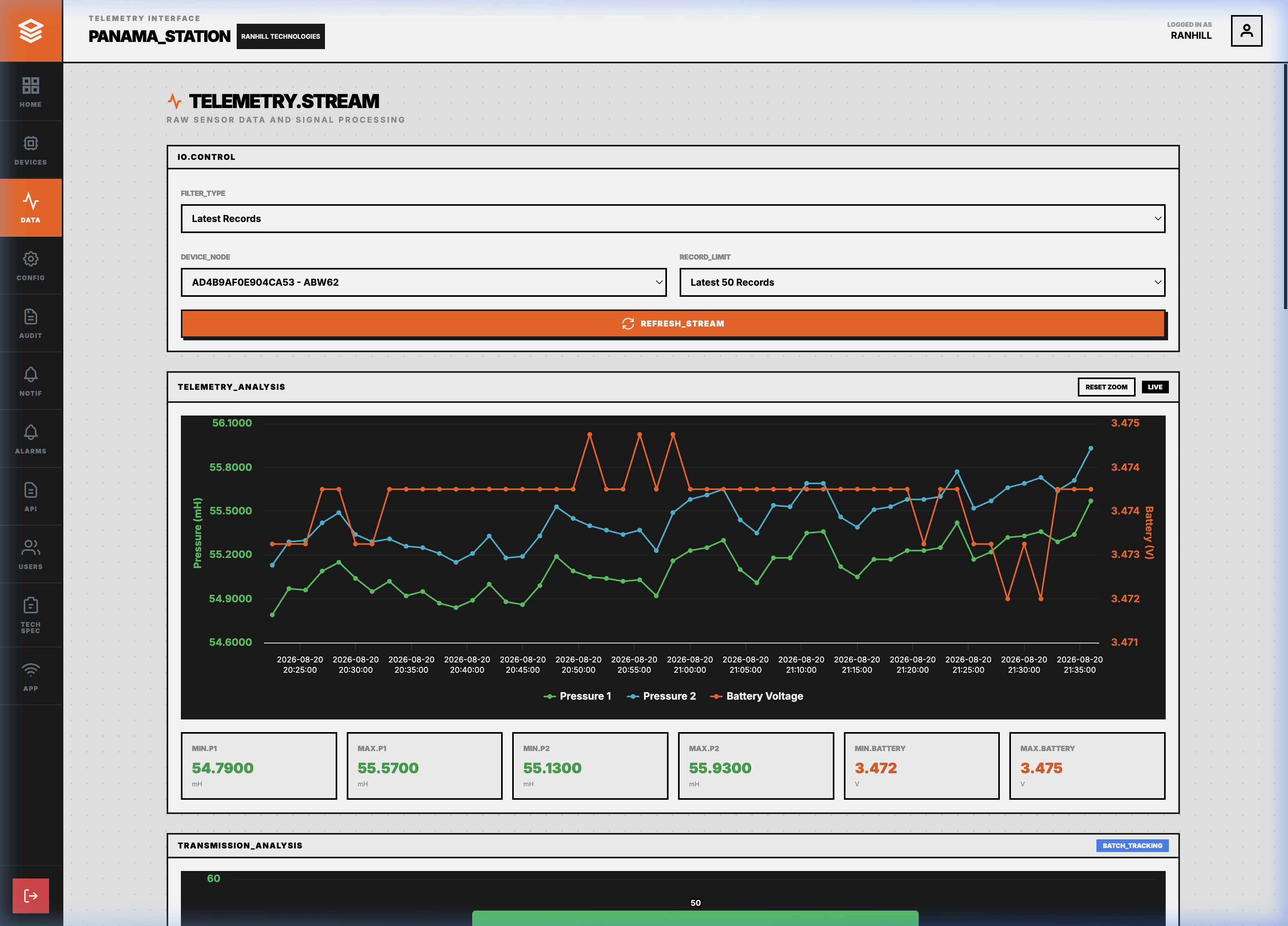
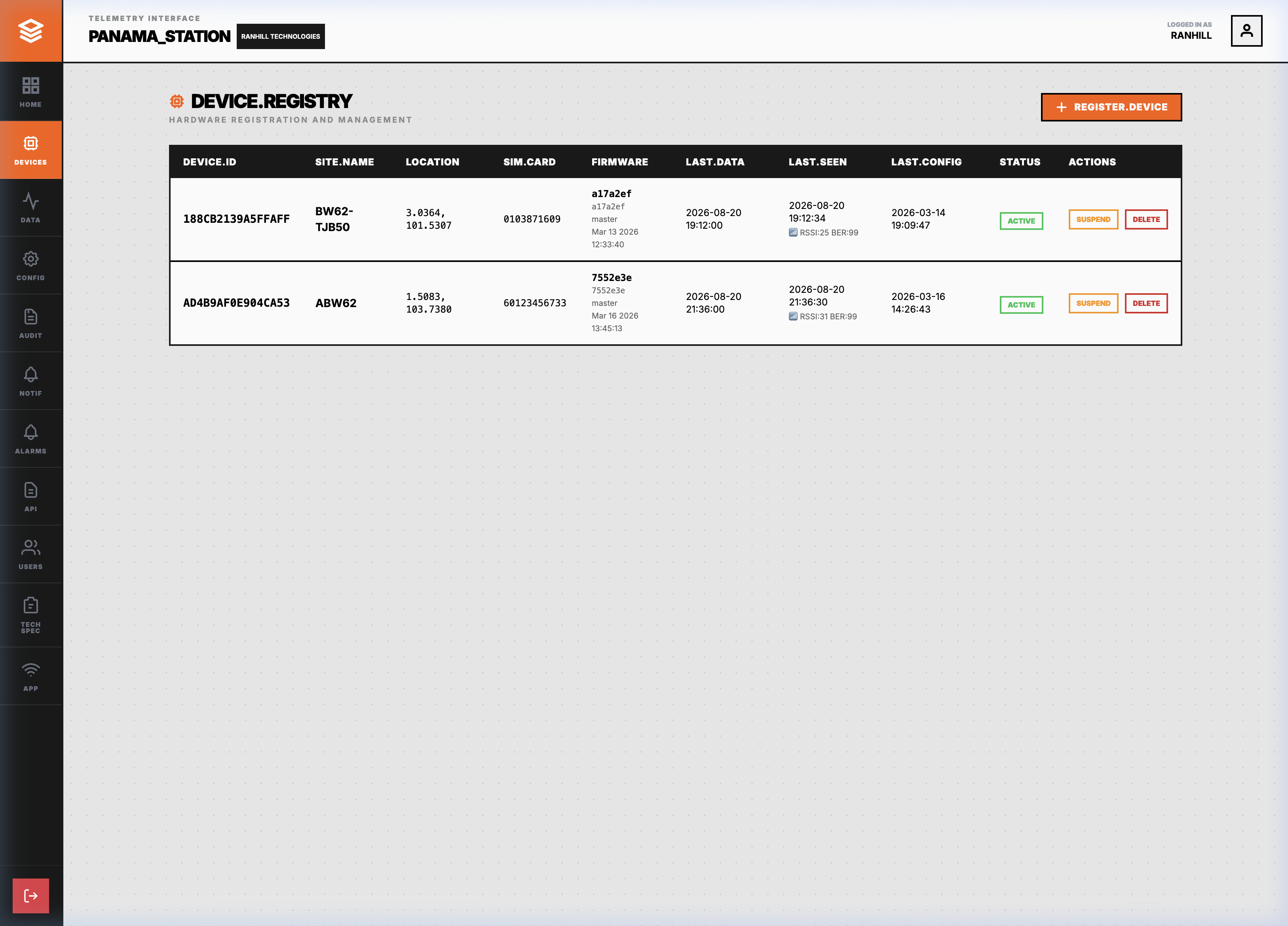
Real-time cloud station for field operations. Ingesting 400,000+ data points with sub-second analytics, live interactive GPS mapping, dual-pressure waveform telemetry, and cellular diagnostics.
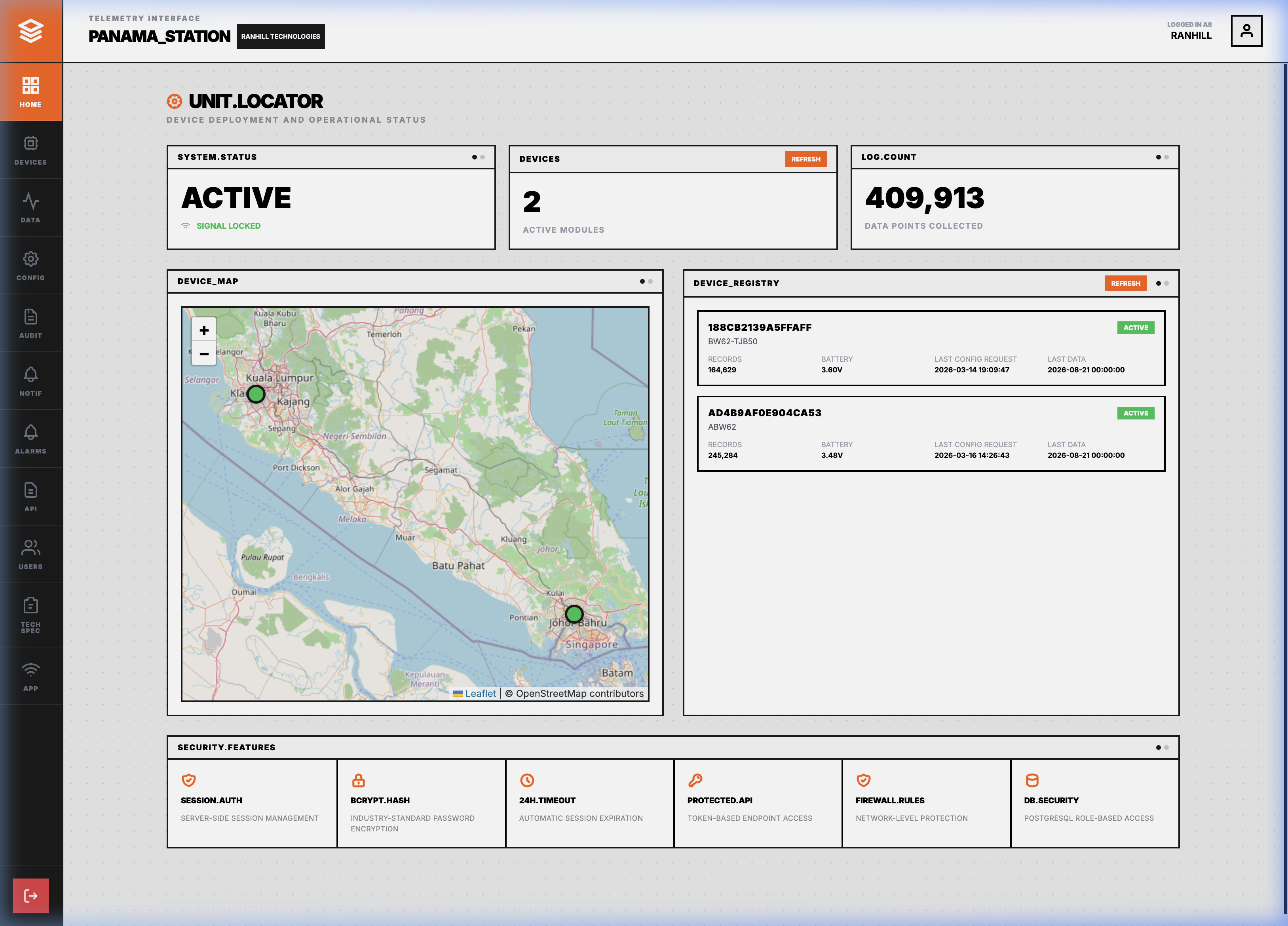
LIVE GPS & METRICS
Geographic pinpointing of active field loggers with instant visual health flags, module counts, and live telemetry.
DUAL PRESSURE CURVES
High-resolution dual channel sensor analysis with min/max aggregates, zoomable timeframes, and instant live stream.
REMOTE FLEET CONTROL
Configure transmit schedules, sampling frequencies, and calibration matrices remotely over cellular airwaves.
WHATSAPP & ALARMS
Instant automated WhatsApp & email alerts dispatched to on-call PICs upon threshold breach with zero spam.
TIME-SENSITIVE ALARMS
& WHATSAPP DISPATCH
Critical water network anomalies require immediate action. Our engine continuously evaluates incoming telemetry against configurable dual-pressure and battery thresholds, instantly routing rich WhatsApp & Email alerts to field engineers.
DIRECT WHATSAPP ALERTS
Connect your company WhatsApp via native QR pairing. Zero external SMS fees. Delivers structured breach reports with site name, coordinates, and exact readings directly to engineering groups.
TIME-SENSITIVE SCHEDULES
Define time-sensitive monitoring schedules (e.g. peak pumping hours vs nighttime low-demand windows). Apply distinct threshold matrices based on operational shifts and duty rosters.
EDGE-TRIGGERED LOGIC
Smart state detection notifies immediately upon entering an alarm state, and dispatches a recovery notification when resolved. Eliminates alert fatigue from repeated pings.
MULTI-TIER THRESHOLDS
Configure dual independent sensor limits (High Pressure, Low Pressure) with 6-decimal precision alongside low battery voltage alarms (e.g. < 3.3V) per district or logger.
OFFLINE FIELD PWA
ZERO CABLES. ZERO INSTALL.
Service underground valve chambers without hauling proprietary cables or laptop adapters. The PANAMA-X Web Bluetooth PWA runs directly inside mobile and desktop Chromium browsers with 100% offline service-worker caching.
LIVE WAVEFORMS & UNITS
Real-time multi-channel canvas oscilloscope with dynamic unit conversion between Bar, PSI, kPa, and Raw Volts alongside live min/max envelope tracking.
75K RRAM LOG & CSV
High-throughput BLE log sync directly from 1.52 MB non-volatile RRAM. Displays dual sensor logs, modem event audits, and enables one-click CSV export.
SAMPLING & PIN MODES
Configure sampling rates (Continuous to 1m), logging intervals, moving memory FIFO overflow strategies, and assign P1.29 pin modes (RS485 / SDI-12 / Pulse).
2-POINT STEP WIZARD
Guided 2-point calibration (Zero Tare + Span Reference) for both pressure channels with live ADC slope verification and instant RRAM coefficient commit.
WHY_NRF54LM20A?
Industrial telemetry demands high-speed acquisition, extreme power efficiency, and seamless wireless field diagnostics. Here's why nRF54LM20A with 5,000 samples/sec and Bluetooth connectivity outperforms the competition.
| Feature |
nRF54LM20A
Norway
|
ESP32-C3
China
|
ATSAML21
USA
|
STM32U0
Europe
|
|---|---|---|---|---|
| Origin | Norway | China | USA | Europe |
| Core Tech | 22nm Cortex-M33 | 40nm Single-Core | 90nm Single-Core | 90nm Single-Core |
| Sampling Rate | 5,000 Samples/s (5 kHz) | 1,000 Samples/s | 1,000 Samples/s | 1,000 Samples/s |
| Local Connectivity | Bluetooth 5.4 (BLE) | BLE 5.0 / Wi-Fi | None (External) | None (External) |
| Field Diagnostics | Web Bluetooth PWA (Offline) | Custom App Required | Serial Cable Only | Serial Cable Only |
| On-Chip Storage | 2.0 MB RRAM | 4 MB Flash | 256 KB Flash | 256 KB Flash |
| Bootup Delay | Instant (10 µs) | Very Slow (50,000 µs) | Fast (15 µs) | Instant (10 µs) |
| Active Power | Ultra-Efficient | High Consumption | Ultra-Efficient | Ultra-Efficient |
| Voltage Range | 1.7V to 3.6V | 3.0V to 3.6V | 1.62V to 3.6V | 1.71V to 3.6V |
22NM_PROCESS_NODE
Advanced 22nm fabrication technology vs. 40nm (ESP32-C3) and 90nm (ATSAML21/STM32U0). Smaller transistors mean better power efficiency, faster performance, and lower heat generation.
5,000_HZ_SAMPLING_&_BLE
High-speed analog acquisition up to 5,000 samples per second with integrated Bluetooth 5.4 connectivity for rapid, wireless on-site technician interfacing.
2MB_RRAM_&_OFFLINE_PWA
2 MB on-chip non-volatile Resistive RAM paired with our offline-first Web Bluetooth PWA (/webapp) allowing field calibration without internet coverage.
THE_VERDICT
For industrial water telemetry, nRF54LM20A delivers an uncompromising single-chip solution: 22nm architecture, 5,000 samples/sec acquisition, Bluetooth 5.4 connectivity, 2MB on-chip RRAM, and offline-capable Web Bluetooth PWA configuration.
HARD_SPECS
Processing_Logic
1. TRANSIENT SAMPLING: Acquire raw 12-bit SAADC readings at continuous 5,000 Hz.
2. RRAM LOGGING: Compute calibrated mathematical aggregates (Mean / Peak Max / Spot) over configurable windows stored into 1.52 MB RRAM.
3. CELLULAR DISPATCH: Pushes encrypted telemetry packets to cloud REST API with edge-triggered WhatsApp alarm evaluation.
SAMPLING_VS_LOGGING.
CONFIGURABLE LATENCY.
Our firmware acquires readings at high-speed 5,000 samples per second (5 kHz), then computes calibrated mathematical averages over configurable windows for transmission. Total control over data density, transient capture, and 4G airtime.
SECURITY.FEATURES
Enterprise protection mechanisms built into every deployment
Send us a WhatsApp message
Tap the button below to open WhatsApp and send your enquiry directly to our sales team. We typically respond within a few hours.
Or manually message +60103871609